On Thursday, May 22, Northampton Mayor Clare Higgins and Department of Public Works Director Ned Huntley stopped by my studio to record an interview about the proposed landfill expansion. I wanted to give them a chance to present their reasons for supporting this project. Listen using the embedded flash player, or download two mp3s using the direct links. This interview will be aired on Sunday, May 31, at 8 p.m. on Valley Free Radio, 103.3 FM. (Sidebar: VFR now has a robust webstream up and running--so you can listen live using iTunes or any other media player on your computer.)
For the record: Here is an interview that Paolo Mastrangelo and I conducted with Citizens United for a Healthy Future, a group which is opposing the landfill expansion. Here is a audio recording of Dr. Robert Newton of the Barnes Aquifer Protection Advisory Committee expressing his concerns about the project in his address to the Easthampton City Council.
landfill_1
landfill_2
Wednesday, May 28, 2008
The Landfill Expansion: Mayor Higgins and Ned Huntley Speak


Monday, April 21, 2008
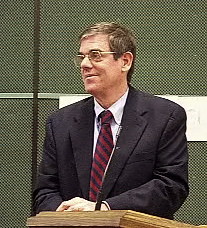
Geologist Robert Newton: Landfill Leachate & the Maloney Well
Geologist (and Smith professor) Robert Newton has studied the Barnes Aquifer extensively in his role as a member of BAPAC--the Barnes Aquifer Protection Advisory Committee. BAPAC operates under the aegis of the Pioneer Valley Planning Commission, and is charged with evaluating, and providing input, on projects that might impact the aquifer, which provides drinking water for Easthampton, Southam[otn, Holyoke, and Westfield.
Northampton is proposing a significant expansion of its existing landfill, which accepts trash from 44 towns, to extend its life for another 20 years. The Department of Environmental Protection (AKA the Executive Office of Energy and Environmental Affairs, EOEA) has determined that the landfill is situated over a recharge area for the Barnes Aquifer. DEP regs prohibit landfills over aquifer recharge areas--yet it has waived these regulations for the city of Northampton.
Dr. Newton asserts that existing studies on the landfill--including the STANTEC report-- are inadequate or flawed.
The landfill expansion will require a special permit from the Northampton City Council, which must give super-majority (2/3) approval.
Dr. Newton explains that an aquifer recharge area consists of gravely, sandy soils that are permeable to rainwater. The Maloney well is surrounded by impermeable clay-based soils, and is recharged from distant locations, which include the existing landfill area.
Three landfills up-gradient from the Maloney well are producing leachate, according to Newton. (Two of these, located in Easthampton, have been decommissioned.) Newton cites evidence that contamination from the landfill has been steadily increasing since 1992.
Newton explained that landfill leachate reduces dissolved oxygen in the groundwater, which precipitates iron and manganese (creating "flocculant" surface water, such as seen in the orange-toned Hannum Brook), and can mobilize naturally-occuring arsenic in rocks. In the scientific literature, iron/manganese flocculance and arsenic contamination are highly related. Western Mass is one area of New England with a high concentration of arsenic-containing rocks. One domestic well downgradient from the landfill has already tested positive for arsenic.
The Maloney well is borderline in its concentration of iron and manganese. Newton argues that pushing more of these metals into the well--and potentially arsenic--is not the answer. It might take 25-50 years for the effects of leachate on groundwater to become apparent. Are we mortgaging our future for a quick, temporary fix?
EOEA # 12351
Friday, March 14, 2008
Tours of Water and Sewer Plants
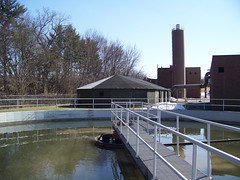
"The Ward Three Neighborhood Association, in cooperation with Ward 3 City Councilor Bob Reckman, has scheduled a public tour of the City's Wastewater Treatment Plant and Flood Control Building on Saturday, March 29 at 10 AM. The plant is located on Hockanum Road. Take the first driveway on the right after you go under the railroad trestle. The tour will be led by Superintendent George Brehm. This facility is well worth seeing, especially the wonderful old flood control building that pumps every year to keep the lowest areas in the City from flooding.
There will be a tour of the City's brand new $24 million Water Treatment Plant on Saturday, May 3, at 10 AM. This plant was opened in late January and provides the City with water that is carefully filtered and therefore requires far less chlorination. The Water Treatment Plant is located on Mountain St. in Haydenville/Williamsburg. Please take the first driveway on the left once you see the Mountain St. reservoir on your right. This tour will be conducted by Alex Roseweir, the chief operator. Parking is limited, so carpooling is encouraged. If you have any questions, please call Councilor Reckman at 413-695-0281."
Wednesday, March 12, 2008
The DPW on Water
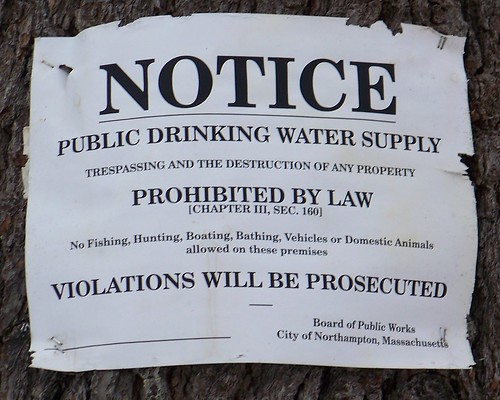
Where Does it Come From,
and Where Does it Go?
Ned Huntley, Head of the Department of Public Works for the City of Northampton, and Dave Sparks, head of the Water Division of the the DPW, answer lots of questions about water filtration ("making water" in the parlance of the profession), delivery, wastewater treatment, and drainage. Why did Northampton have to build a $28 million water filtration plant? How does this plant, which is capable of delivering 6.5 millions of gallons a day, work? Do we have enough water to meet our future needs? How do we protect our supply? Are the delivery pipes in good condition? Is the plant run by City employees, or are we outsourcing its operation?
Is stormwater--a notorious non-point source of pollution to environmental planners--adequately monitored and managed? And wastewater--how exactly is sewerage treated? Does it get dumped into the Connecticut? How clean is it at that point? What do we do with the sludge? Is the entire water delivery and disposal system energy-intensive?
Oh...both Ned Huntley and I want that job where you get to drive around in an orange DPW truck and patrol watershed land in Williamsburg. Too bad; I'll bet he's a bit more qualified than I am.
Watch as a slide show/video, or download the mp3 using the direct link:
northampton_water.mp3

